
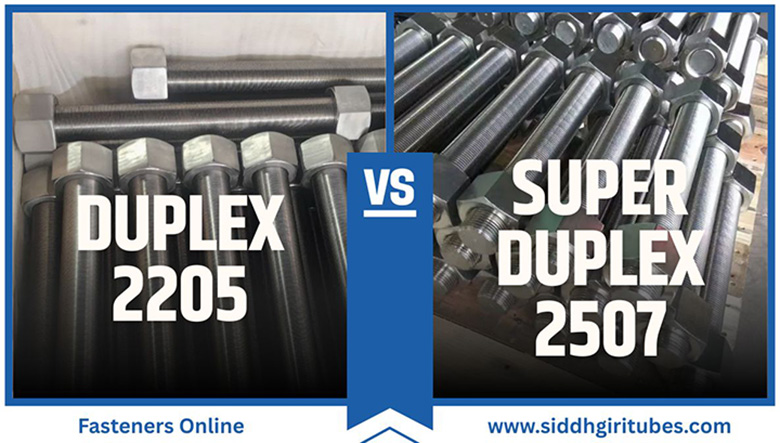
2507 Super Duplex is engineered for higher load bearing capacity
What is Duplex 2205?
Duplex 2205 is high performance alloy which is used in application which requires good corrosion resistance and strength. It contains upto 22% chromium, 5% Nickel and upto 3% Molybdenum. Additionally nitrongen is added in it to boost its mechanical strength and pitting resistance. Duplex 2205 is the cost effective solution for less aggressive environments.
What is Super Duplex 2507?
Super Duplex 2507 is known for its exceptional strength and superior corrosion resistance and primarily used in chloride rich marine and industrial environments. It belongs to duplex family which means it has mixed microstructure of austenite and ferrite. It contains roughly 25% chromium, 7% nickel, 4% molybdenum, and nitrogen. Alloy 2507 has Extremely High Mechanical Strength and Resistance to High Temperature and Pressure.
SAF 2507 is approximately 25% stronger than Alloy 2205 material
Chemical Composition of Super Duplex 2507 Vs Duplex 2205
| Element | Duplex 2205 | Super Duplex 2507 | Why It Matters |
|---|---|---|---|
| Chromium (Cr) | 21.0 – 23.0% | 24.0 – 26.0% | Primary corrosion barrier |
| Molybdenum (Mo) | 2.5 – 3.5% | 3.5 – 4.5% | Pitting & crevice resistance |
| Nickel (Ni) | 4.5 – 6.5% | 6.0 – 8.0% | Austenite stabiliser, SCC resistance |
| Nitrogen (N) | 0.14 – 0.20% | 0.24 – 0.32% | Strengthens & boosts PREN |
| Carbon (C) | ≤ 0.030% | ≤ 0.030% | Kept low to prevent sensitisation |
| Manganese (Mn) | ≤ 2.0% | ≤ 1.2% | Austenite former |
| Silicon (Si) | ≤ 1.0% | ≤ 0.80% | Deoxidiser |
| Phosphorus (P) | ≤ 0.030% | ≤ 0.035% | Kept low — impairs toughness |
| Sulphur (S) | ≤ 0.020% | ≤ 0.020% | Kept low — impairs corrosion resistance |
Super Duplex 2507 has higher chromium, molybdenum, and nitrogen compared to Alloy 2205
Comparison of SAF 2507 vs Alloy 2205 Mechanical Properties
| Property | UNS S31803 | UNS S32750 |
|---|---|---|
| Proof Strength (min) | 450 MPa | 550 MPa |
| Tensile Strength | 620 – 820 MPa | 750 – 950 MPa |
| Hardness (Brinell, max) | 293 HBW | 310 HBW |
| Impact Toughness (Charpy) | Good down to –46°C | Good down to –50°C |
| Density | 7.82 g/cm³ | 7.80 g/cm³ |
Super Duplex 2507 has higher PREN value compared to SAF 2205
Corrosion Resistance: 2205 vs 2507
| Property | Duplex Steel 2205 | SAF 2507 |
|---|---|---|
| PREN (Pitting Resistance) | ~34–36 | ~40–45 |
| Chloride Environment Performance | Strong | Exceptiona |
| Best For | Moderate chloride and industrial use | Severe offshore and marine conditions |
Difference between Thermal Properties and Temperature Limits of Duplex 2205 vs SDSS 2507
| Thermal Property | WNR 1.4462 | WNR 1.4410 |
|---|---|---|
| Max continuous service temp | 300°C (572°F) | 280°C (536°F) |
| Thermal conductivity (20°C) | 19 W/m·K | 14 W/m·K |
| Low-temperature service limit | –46°C (–51°F) | –50°C (–58°F) |
| Sigma phase embrittlement risk | Above 300°C | Above 280°C |
| 475°C embrittlement risk | Above 300°C | Above 280°C |
Weldability and Fabrication of DSS 2205 vs Alloy 2507
| Property | SDSS 2507 | SAF 2205 |
|---|---|---|
| Filler metal | ER2594 for GMAW/GTAW | ER2209 for GMAW |
| Heat input | Very controlled — typically 0.2 to 1.5 kJ/mm | Low to medium — typically 0.5 to 1.5 kJ/mm |
| Interpass temperature | Maximum 100°C | Maximum 150°C |
SDSS 2507 typically costs 30–50% more than Alloy 2205
Cost Comparison of Duplex 2205 vs Super Duplex 2507
| Cost Factor | Duplex 2205 | Super Duplex 2507 |
|---|---|---|
| Raw material premium vs 316L | ~30–60% higher | ~80–130% higher |
| Price relative to 2205 | Baseline (1×) | Approximately 1.5 – 2.0× |
| Fabrication cost premium | Low | Moderate |
| Inventory availability | High | Lower |
| Wall thickness savings | Some reduction vs 316L | Greater reduction due to higher strength |
| Life cycle cost | Higher maintenance | Lower maintenance |
Features of Duplex Steel 2507 VS 2205
| Parameter | Duplex 2205 | Super Duplex 2507 |
|---|---|---|
| UNS Number | S31803 / S32205 | S32750 |
| EN Number | 1.4462 | 1.441 |
| PREN | ~34–36 | ~42–43 |
| Max Chloride Tolerance (approx.) | Up to ~25,000 ppm at <40°C | Up to ~50,000 ppm at <60°C |
| Max Service Temperature | 300°C | 280°C |
| SCC Resistance | Excellent | Superior |
| Pitting Resistance | Very Good | Excellent |
| Weldability | Good | Moderate |
| Machinability | Good | Moderate |
| Best for | Moderate corrosive environments, cost sensitive projects | Severe corrosive environments, critical long life assets |
Duplex 2205 is the widely used for moderate corrosive environments
Application of Duplex 2507 vs 2205
Industry applications of Alloy 2205
- Oil and Gas
- Chemical Processing
- Pulp and Paper
- Desalination
- Architecture and Structural
- Food and Beverage
- Power Generation
Industry applications of SDSS 2507
- Subsea and Deepwater
- Offshore Platforms
- Desalination
- Chemical Plants
- Geothermal Energy
- Pharmaceutical
- Sulfuric acid plants
Selection Criteria to choose between Alloy 2507 and SAF 2205
When Duplex 2205 Is the Better Choice
Duplex 2205 is a practical option for applications where chloride levels are moderate and the operating environment is not extremely aggressive. It performs well in systems that are not exposed to direct seawater or conditions that promote heavy crevice corrosion from deposits or stagnant areas.
When Super Duplex 2507 Is the Better Choice
Super Duplex 2507 is designed for highly aggressive chloride environments where maximum corrosion resistance is essential. It is the preferred material for direct seawater service, desalination plants, offshore immersion or splash zones, and applications with high chloride concentrations. Super Duplex 2507 also offers greater mechanical strength than Duplex 2205, making it suitable for demanding structural and pressure applications.